01
As part of a design project
In Packaging, POSM or Print Design projects, the prepress mindset is there from the start. We don’t fix at the end what could have been avoided during design.

06 / 06 · Prepress & Production Consulting
A print error rarely starts when the press starts. Often it’s already in the file, the dieline, the color setup or a wrong production decision.
In a prepress audit and production consultation I check whether the artwork, the technology and the production expectations actually fit together – with your printer, wherever it is, or with mine.
PackagingPOSMLabelsPrintCatalogs
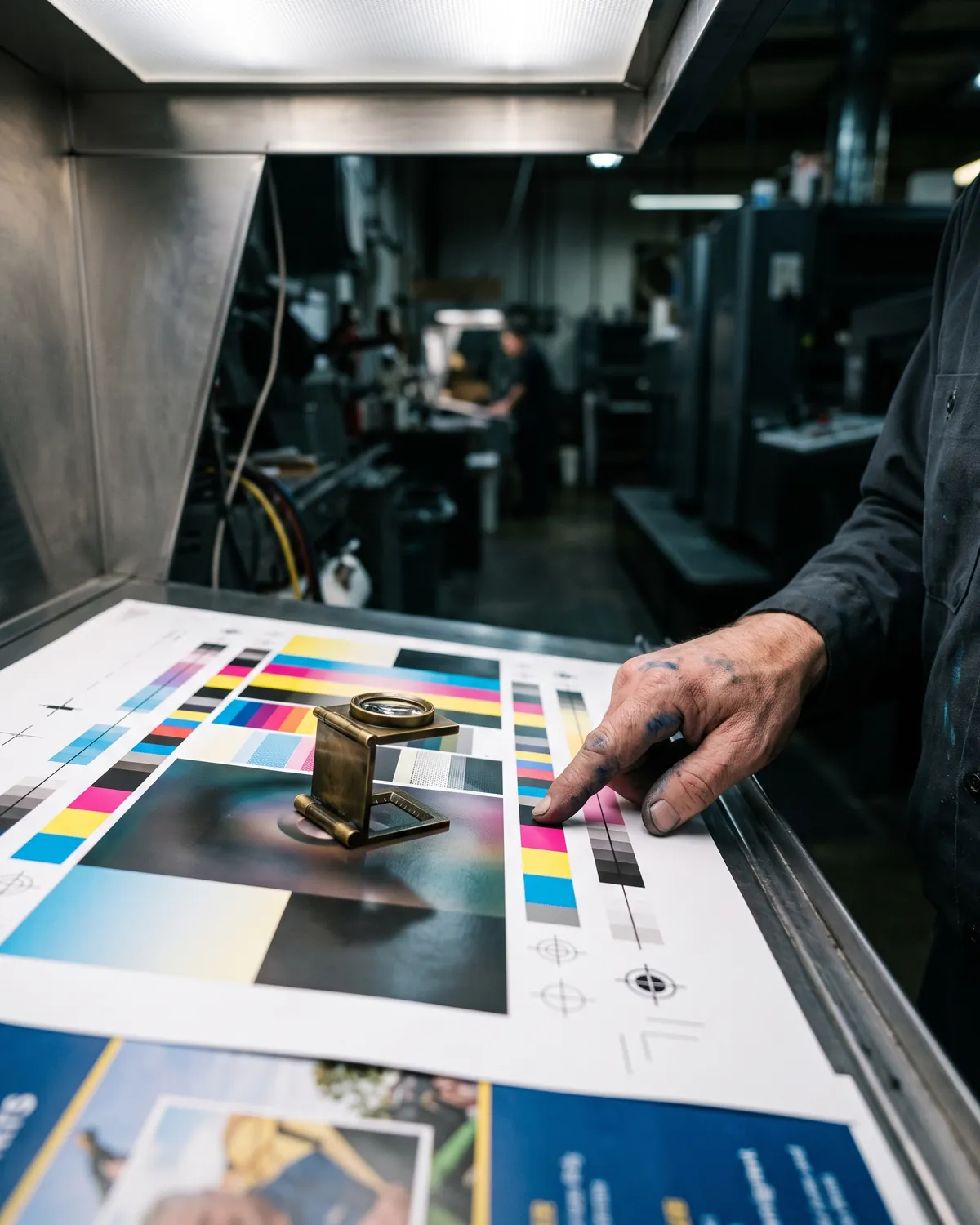
Stand-alone or as part of a design project
In Packaging, POSM or Print Design projects, the prepress mindset is there from the start. We don’t fix at the end what could have been avoided during design.
If someone else made the artwork but you want an independent check before production – or several printers tell you different things, costs are high, there’s a color problem or the dieline is uncertain.
Production, wherever you print
Worldwide.
Production-ready artwork built to your printer’s specifications: color setup, dielines, ink limits, finishing layers, barcodes – checked and documented.
Worldwide, remotely.
I talk to your local printer or converter directly: specs, file handover, proof review and press-check guidance – so nothing gets lost between design and production.
EU delivery.
End-to-end production through trusted printing partners in Central Europe: offset, digital, packaging, POSM and finishing – one point of contact from file to delivery.
Most international clients start with level 01 or 02. Full production makes the most sense for EU-based projects, where logistics and lead times work in your favor.
Typical situations
Maybe the design isn’t the problem – it may be the size, the construction, the number of colors or the technology.
I help separate what’s a technological need, what’s a manufacturer preference and what’s actually in the project’s interest.
Good on screen, different on the proof, different again in print: wrong conversion, ICC logic, ink coverage or a bad build.
It worked before – but with a different board thickness, the same construction may no longer be right.
Not a problem in itself. But if the questions keep multiplying, it’s worth checking how stable the artwork really is.
Prepress audit
An automatic preflight only checks what it has rules for. I also look at how the file will behave in the specific production environment.
The question isn’t whether it exports to PDF. It’s whether it can be produced safely.
Technical details that matter a lot
Excessive Total Ink Coverage gets corrected automatically by the printer’s RIP – but not in a controlled way. Color management belongs in the artwork: TAC, CMYK conversion, Pantone, black build.
A barcode doesn’t need to be built from four colors. Barcodes, QR codes, small text, thin lines, legal info: single-color black is often the safe choice.
What looks great at 200% zoom can be illegible in print. I don’t just check size: font, weight, color build, substrate, technology.
A smooth gradient on screen can turn stripy in print – depending on color mix, rasterization and the RIP.
The same shape on a different material is no longer the same construction. A dieline isn’t just a red line on top of the artwork.
Between the two sides
Wants to keep the visual concept.
Wants to produce safely and predictably.
Wants the expected quality at a controllable cost.
I don’t automatically side with the designer. Or with the printer. I side with the project.
Cost optimization
A small size change can mean better sheet utilization or simpler production.
Another dieline can reduce material use or simplify assembly.
Not every print run is economical with the same technology.
An extra spot color doesn’t always add as much value as it costs.
If versions differ only partly, they can be designed so not every version needs a new plate set.
Equipment, experience, quality, run length, finishing, deadline, communication. Choosing a printer is a risk decision too.
File rescue
If the error is known and localized, it can often be fixed quickly. But sometimes fixing means disproportionate time and uncertainty:
Not every Canva export is unusable – but for a serious production project, I wouldn’t base print safety on it.
Audit scope
How does an audit work?
What the product is, which technology, which manufacturer, what the problem is and what we should check.
If available, I compare the manufacturer’s technical requirements with the artwork.
Technical and visual review.
Critical errors, production risks, optimization opportunities and good-practice improvements – in separate categories.
What must be changed, what’s worth changing and what can stay as is.
Fixes, instructions for your designer, coordination with your printer or production alternatives.
How is it priced?
A predefined audit fee for a well-defined artwork or project.
A base consulting fee with a defined time budget, hourly rate beyond that.
Prepress is built into my own Packaging, POSM and Print projects from the start.
If the project needs production coordination – with your printer or my partners – we handle it as a separate scope.
The audit result can include: issues in order of priority, production risks, fix and cost-optimization recommendations, technology alternatives, and instructions you can pass on.
Three main outcomes
What I don’t take on
I don’t do a full audit with a “just look it over in half an hour” expectation – real risks don’t necessarily show up in an automatic preflight.
It’s useful, but not necessarily enough on its own. It checks rules – it doesn’t understand the design intent, the construction or the specifics of the technology.
Yes. The audit doesn’t require me to have made the design.
Yes, by agreement. Simple errors can be fixed directly; in more complex cases the source file has to be partly or fully rebuilt.
Yes, if it helps the solution – especially when a requirement has to be clarified between designer and manufacturer. This works remotely with printers anywhere.
Yes. Print-ready files and coordination with your printer work worldwide. Full production through my own partners is offered for EU delivery.
Yes, I have proven partners in Central Europe for certain jobs. The choice always depends on the project’s technological needs.
I don’t offer a stand-alone proof-checking service.
It depends on the complexity – a packaging artwork and a several-hundred-page catalog are completely different. Once the scope is known, it can be defined in advance.
A well-defined audit can have a fixed project price. For more open consulting, a base consulting fee plus hourly rate as needed is the sensible model.
Before it goes to press
If you’re unsure about the print file, the technology, or whether the printer’s suggestion really serves your project, let’s review it before production.
Part of one system