!1
The KV only works in portrait
Photo, headline and product were composed for one layout. Then an extra-wide shelf format arrives – and the layout falls apart.

02 / 06 · POSM & Retail Communication
A campaign has to deliver the same brand experience on a shelf talker, a poster, a display or a cooler sticker – even when every retailer asks for a different size and format.
I build retail design systems that let your campaign adapt consistently, roll out faster and go into production more safely.
FMCGBrandTrade marketingProduct companies
Sound familiar?
Most retail campaigns don’t get difficult because of a bad idea – but because the original key visual was designed for one aspect ratio only.
Photo, headline and product were composed for one layout. Then an extra-wide shelf format arrives – and the layout falls apart.
Every new size is a separate decision: where does the headline go, how big is the logo, which product stays? Without rules, every adaptation becomes a slightly different campaign.
One chain asks for its own size, another for a different substrate. The more custom requests, the stricter the system needs to be.
Retail opportunities often arrive late. There’s no time to design a new campaign – what exists has to be adapted well, and fast.
The outcome
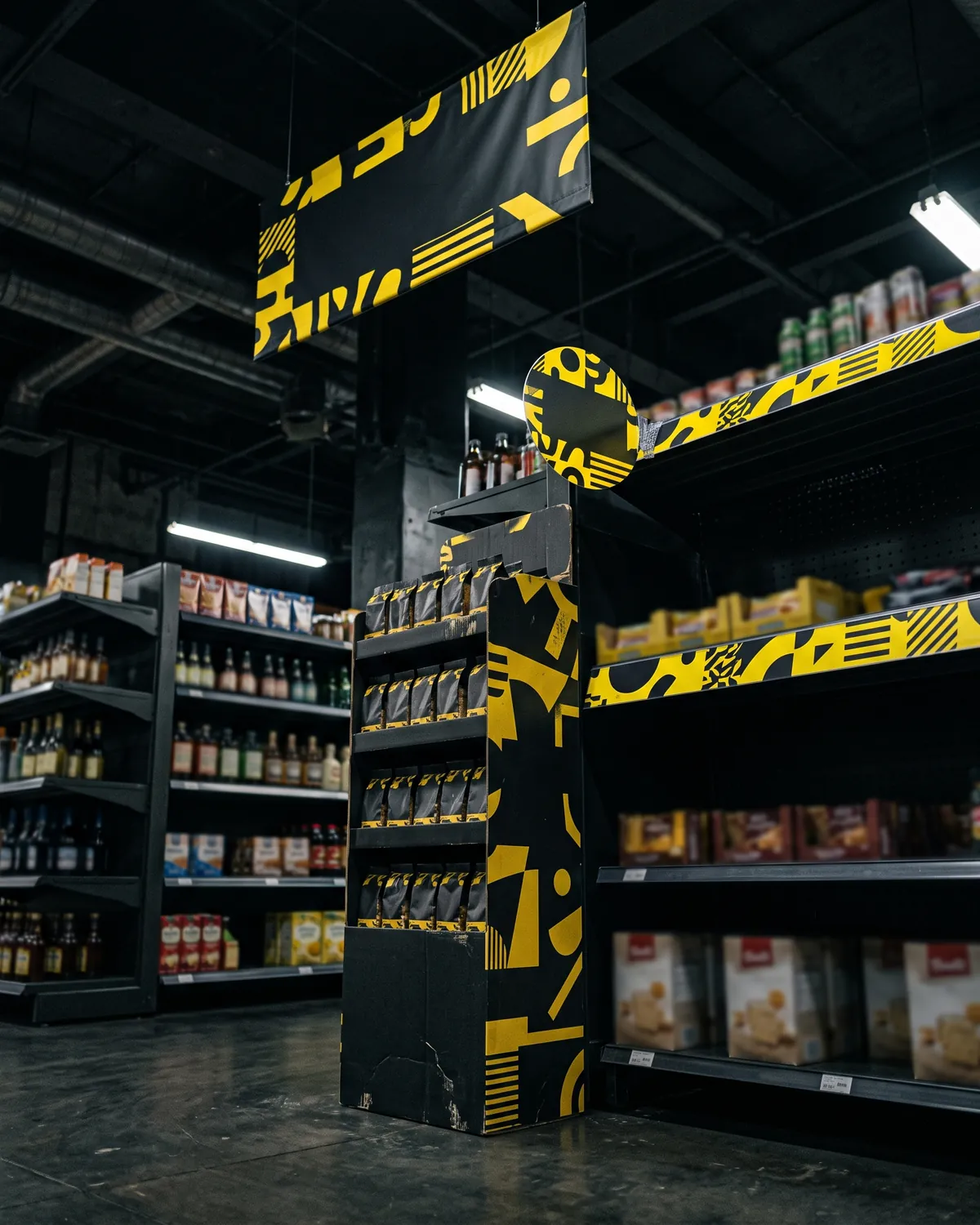
Shoppers see the same brand on a small shelf talker and on a large display.
With a good master system, a new format isn’t a redesign: the rules tell you how to translate it.
The design follows the manufacturer’s specifications, and we align with the production partner during the process.
A modular system simplifies future adaptations and cuts unnecessary redesign.
Retail touchpoints
Master KV → retail system
Squeezing a portrait key visual into a landscape format may be technically correct – it still won’t communicate. So for every campaign I define:
What stays on every format, and what can be dropped on a smaller surface?
What dominates: the product, the campaign message, the brand or the promotion?
A framework that keeps the campaign’s character across different aspect ratios.
Imagery is planned so it works on both portrait and landscape formats.
The more variants, the more precisely we need to define what can move and what can’t.
More sizes. Same system.
A large display can tell a story. A small POSM has to get the message across in seconds. Modularity delivers consistency and usability at the same time.
Retailer mutations
In national campaigns, the same communication often has to be adapted to several retail chains’ own specifications. What can differ:
The goal: the right artwork for every retailer – while the campaign still feels like one campaign everywhere.
Case study
Borsodi’s new visual communication had to be carried across a wide range of retail and POSM formats – different sizes and structures, changing retail environments and tight deadlines.
Related projects
Design + production
They know the material, the construction, the machinery, the production limits and the current capacity.
I build these parameters into the design from the start and align with the partner during the project as needed.
With a clear brief, timely approvals and secured capacity, the full rollout can be coordinated. I don’t take production responsibility for uncontrolled rushing.
Speed matters. Unpredictability is not the same thing.
Master → variants → Brand Vault
Once every variant is done, we review the whole series together – not just one by one, but as a campaign. Approved artworks go into the Brand Vault, so a wrong version can’t end up in production later.
How we work together
Campaign goal, target group, retailer list, formats, quantities, budget, deadline, installation needs, KV, photos, copy and brand guidelines.
I assess how adaptable the existing key visual is, and we set the rules that guide the variants.
Content and visual hierarchy, grid, image handling, product placement, CTA logic. The master gets approved first.
Sizes, formats, POSM pieces and retailer variants are produced.
We review the campaign as a whole, so every element truly forms one system.
Artworks are delivered to the manufacturer’s specifications – for your printer or ours.
With the right capacity and a clear schedule, production and installation can also be coordinated.
Who is it for?
When is it not the right fit?
If you need a single artwork resized instantly, with a deadline that doesn’t allow rethinking the layout, we’re probably not talking about a design system project.
Urgent adaptations happen – but reliable retail communication doesn’t come from working that way.
Yes, that’s the most common starting point. First I assess how adaptable the KV is, and if needed I build a master grid and hierarchy for it.
Very common. We don’t rotate or squeeze the layout: we look at the mandatory elements and build a new composition that keeps the visual character.
Yes. It’s worth collecting retailer-specific requirements in the brief, so we can handle the differences from one master system.
Technically yes, but this service is built for multi-format communication systems. A single small artwork doesn’t need the full systems approach.
It depends on the project. With a clear brief, realistic deadline and secured capacity – yes, through our Central European partners for EU rollouts. For campaigns outside the EU, I prepare the files for your local printer and support them on proofs and specs.
Depending on the project and the production partner, yes – within the regions our partners cover.
I check what artwork exists, which formats are needed, what the specs are and how much time there really is. If it can’t be done safely, I say so up front – not the day before production.
It depends on the state of the master, the number of formats and retailer variants, creative changes, the deadline and the production tasks.
I don’t use fixed web rates for custom projects. After the project brief, we discuss the task in a 30-minute strategy call, and you receive a clear scope and proposal based on it.
Next step
Show me the key visual, the retail formats and the project framework.
Part of one system