!1
A new product family is launching
The first product is in the works, but new sizes, flavors, variants or SKUs are already on the horizon.
If the first design isn’t built as a system, every following variant can turn into a redesign.

01 / 06 · Packaging Design & Design Systems
I build a visual and production system that carries forward consistently to your next SKUs, sizes, markets and seasonal variants.
The goal: packaging that builds brand value, scales well – and works on press.
FMCGProduct companiesGrowing brands
Sound familiar?
The first product is in the works, but new sizes, flavors, variants or SKUs are already on the horizon.
If the first design isn’t built as a system, every following variant can turn into a redesign.
The products belong to the same brand, yet they don’t feel like a family.
Different hierarchies, too many colors, shifting typography and inconsistent back panels weaken the shelf impact.
With every new SKU you have to decide again where the product name goes, which color to use, where the image sits.
That’s not adaptation. That’s starting over every time.
The creative is done, but it isn’t technically prepared for production.
Dieline issues, wrong bleed, mishandled spot colors, excessive ink coverage or a faulty barcode – all cost time and money later.
The outcome
At first glance, every product belongs to the same brand – while each SKU is easy to tell apart.
Stronger shelf presence. Stronger brand equity.
When the next product arrives, we don’t start from a blank page.
The master layout, grid, hierarchy, color logic and panel structure already define how it fits in.
Material, printing technology, dieline, folds, gluing, finishing and prepress are part of the decisions from the start.
Fewer surprises at the printer.
How the system is built
Depending on the size and complexity of the project, we build the system from these elements.
How products, SKUs, sizes and variants relate to each other.
What does the shopper notice first? What comes second? What can be background information?
The core visual from which the whole product family can be built consistently.
A stable framework that keeps consistency across different pack sizes.
We differentiate products without turning every SKU into a separate brand.
Front and back panel communication is designed as a system too.
Legibility, information levels, minimum sizes, consistent usage.
We work with existing dielines, but I can also create a new structure when needed.
Placement of legal copy, pictograms, technical information and multilingual content.
EAN code generation when needed, plus the technical setup required for reliable production.
Not a mockup: files that are genuinely prepared for print production.
Rules for extending the system to new SKUs, sizes and promotional variants.
Master design → SKU family
Systems thinking pays off from the second pack. With three, five or ten SKUs, it’s not an extra – it’s the baseline.
The system defines up front what stays constant and what can change per SKU. That way a new flavor, size or seasonal variant doesn’t break the family.
Case study
The Activity Table products differ in size, content and function, yet they have to appear as one product family.
The task wasn’t to design a box, but a packaging system that works across several product types, pack sizes and future variants.
Related projects
Production know-how
Production decisions don’t start when the printer sends the first question. They are part of the design from day one.
Paper, board, caliper and surface properties.
Folds, glue areas, flaps, closures, technological limits.
CMYK, Pantone, spot colors, white underprint, preparation matched to the print process.
Lamination, varnishes, foils and other finishing.
Color profiles, total ink coverage, settings matched to the technology.
Minimum type size, line weights, proper contrast.
Size, contrast, placement, technical preparation.
Print PDF, bleed, trim box, spot colors, overprint – everything production shouldn’t have to fix later.
Printing outside Hungary? The files are built to your printer’s specs – and I can work directly with them on proofs and press checks.
Not just the graphics
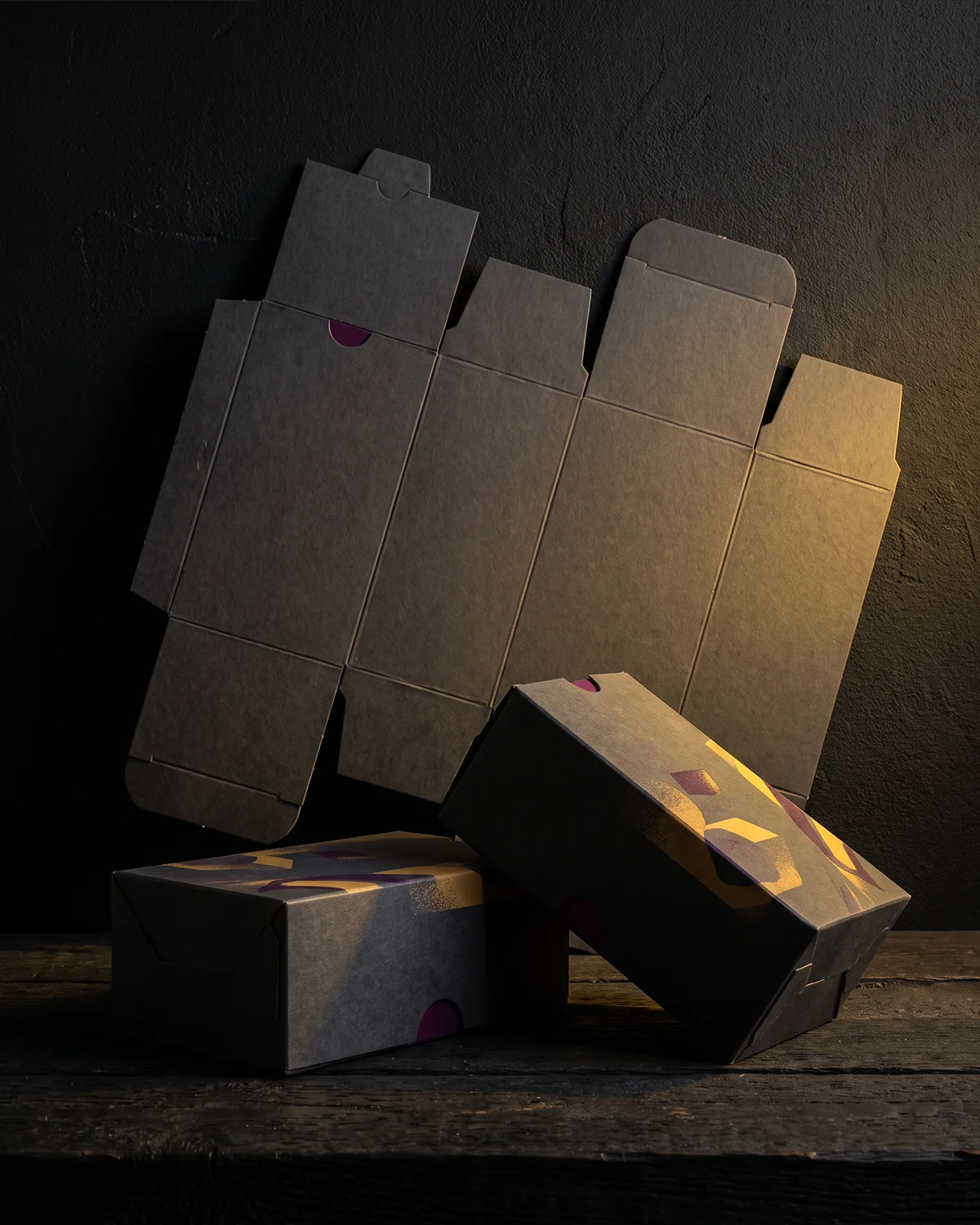
I work with a dieline library built on hundreds of base structures, from which the right construction can be developed for your product, board caliper and production technology.
If your manufacturer supplies a dieline, I review it before the artwork starts – and flag any issue I find.
That way, a structural decision isn’t tested for the first time on tens of thousands of printed units.
A clean handover
Every SKU is handed over in a structured, print-ready package.
Three standard PDF/X files for every pack:
Accurate trim and bleed boxes, production data in the slug area.
Packs are built on master pages, so critical elements land in exactly the same place on every SKU.
Consistency isn’t eyeballed.
Presentation mockups for every SKU – for sales, listings and your online store.
Brand Vault
Every project gets its own secure Brand Vault access. It always holds the latest approved version.
This reduces the risk of an old or faulty artwork making its way back into production months later.
How we work together
I get to know the product, budget, competitors, manufacturer and technology, the planned SKUs, markets and languages, the dieline and future seasonal needs.
We define the information hierarchy, SKU logic, product names, color system, master layout and front/back panel structure.
The master design and the visual language of the product family take shape.
SKUs, sizes and adaptations are built from the approved concept.
Final PDF/X print files and full documentation are delivered.
From choosing the manufacturer through prototypes to full production – with your printer, or with our partners in Central Europe.
Who is it for?
When is it not the right fit?
This service isn’t built for emergency design fixes. If you need a complete redesign within a few days, there isn’t enough time to think the system through.
I also don’t take on technical rescues of Canva- or Word-based artwork – fixing them often takes longer than rebuilding them in a proper workflow.
The production budget can be tight. The design system still has to be precise. In fact, that’s when it matters most.
It depends on the number of SKUs, the content and the complexity of the structure.
The first phase is always building the system, so it takes more time than a single isolated artwork. In return, every following SKU stands on more stable foundations.
We can. But if we already know more products will follow, it’s worth making the decisions that affect the whole family on the first one.
A single SKU can be perfect – and then the fifth one reveals that the system doesn’t scale.
Yes. I technically review the dieline before starting and flag any problem I find. If needed, I also prepare it from a print production point of view.
Yes. Starting from a wide range of standard constructions, a custom dieline can be made for your product, board caliper and technology. A physical prototype can be made if needed.
Yes. The artwork is delivered production-ready, so the printer of your choice – anywhere in the world – can process it. If you’d like, I can also organize production.
Yes. I prepare the files to your printer’s specifications and can handle proofs and technical questions with them directly. For EU clients, full production through our Central European partners is also an option.
Yes. Multiple languages affect the information hierarchy and the available space from the start, so the earlier we know, the better.
That’s common. We can start the system with placeholder content, but the final artwork can only be closed with approved images, copy and mandatory information.
The scope depends heavily on the number of SKUs, the structure, the content, the adaptations and the production tasks.
I don’t use fixed web rates for custom projects. After the project brief, we discuss the task in a 30-minute strategy call, and you receive a clear scope and proposal based on it.
Next step
If you’re launching a new product or product family, it pays to build foundations with the very first pack that won’t limit you later.
Part of one system